

Ecommerce Checkout Solutions: Top Tools to Improve Conversions and Sales
Checkout is the final stage of any online transaction, where the buyer enters their information, selects a payment method, and completes their order. It’s the end of the purchasing journey, and your checkout process determines whether that journey results in a sale.
Studies have shown that the average cart abandonment rate is 70.19%. That’s a large number of buyers who are about to purchase and then change their minds. This is the reason why so many companies now invest in real-time checkout fixes rather than simply marketing or product pages. It can be for many reasons, such as a long checkout process, security issues, or a lack of multiple payment options.
eCommerce checkout solutions address that gap. They simplify the payment process, support the payment methods that consumers choose, provide enough security, and reduce the friction that causes individuals to leave the page midway.
In this guide, we’ll go through how these solutions work and the features to look out for in 2026.
What Are eCommerce Checkout Solutions?
A checkout solution lets customers purchase and pay for your products or services. Once the transaction is completed, it collects their details, processes the payment, calculates shipping and tax, and confirms the order.
Most solutions allow you to accept multiple payment methods such as cards, UPI, wallets and Buy Now Pay Later. The more options you give your customers, the less likely they are to abandon the sale at the last minute.
There are the main types of eCommerce checkout solutions:
- Hosted Checkout: your customer is redirected to your payment provider’s page to pay, then returns to complete the order.
- Integrated Checkout: payment happens right on your website. No redirects, no extra tabs.
- One-Click Checkout: for returning customers. Their details are already saved, so they can check out in a few seconds.
A reliable checkout solution also keeps payment and customer data secure by adhering to industry-standard security practices. It helps you get paid faster, reduce drop-offs, and make the buying experience smoother for buyers.
Which eCommerce Checkout Solutions Stand Out in 2026?
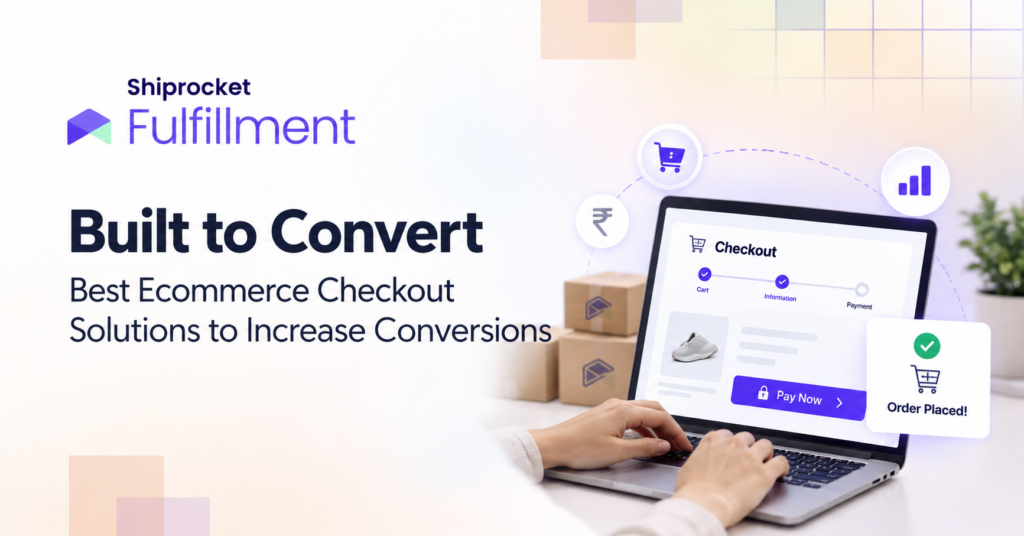
Here’s what the major checkout solutions offer in 2026:
- Fastrr Checkout
Built for D2C and ecommerce brands, fastrr Checkout focuses on reducing friction during the buying journey. Powered by the Shiprocket buyer network, it enables faster checkouts with minimal typing, while AI-powered payment routing helps improve payment success rates. It also supports personalised checkout experiences, smart COD controls, prepaid nudges, and real-time delivery estimates to help brands increase conversions and reduce cart abandonment.
- Stripe Checkout
You get over 75 payment methods, including cards, digital wallets, bank transfers, and BNPL. It handles 135+ currencies and 35+ languages, which matters if you sell outside your home country. You can run it as a hosted page or embed it directly into your site. Subscriptions and recurring billing are already built in, so you don’t have to add them on separately.
- Shopify Checkout
If your store is powered by Shopify, this is the default option. Shop Pay saves customers’ information, so the next time they buy, the checkout process takes seconds rather than minutes. It connects to many payment gateways, does fraud checks in the background, and is mobile-friendly.
- PayPal Checkout
With this tool, you can simplify international tasks. It also accepts PayPal balance, cards, and other payment methods. Since it handles multiple currencies without much fuss, it’s a reasonable choice if you have customers overseas.
- Razorpay Checkout
It supports UPI, cards, wallets, net banking, EMI, and Band NPL. This tool also features address auto-fill, OTP-based checkout, and features designed to reduce checkout time for Indian shoppers.
- Cashfree Payments
Cashfree also offers a broad range of payment options, including UPI, cards, net banking, wallets, EMI, and BNPL. It also features instant payment confirmation, split payments, and refunds that don’t take days. You can easily connect with most eCommerce platforms already in use.
- GoKwik Checkout
Built around one-click checkout and phone-number login, with address auto-fill and COD verification thrown in. It also flags fraud before it becomes a problem. A lot of D2C brands use it specifically to get more of their orders paid upfront instead of cash on delivery.
Which Features Should You Prioritise in an eCommerce Checkout Solution?
Not every eCommerce checkout solution offers the same features. Before choosing one, check for the following features:
- Multiple Payment Options: Around 10% of online shoppers abandon their purchase when their preferred payment method is unavailable. UPI, cards, net banking, wallets, EMI, BNPL, the more of these you support, the fewer customers you lose at the last step.
- Fast Checkout: 17–18% of shoppers abandon checkout because the process is too long or complicated. Look for features like auto-fill, saved details, and one-click payment. Every field that a customer doesn’t have to type is one less reason to abandon the cart.
- Mobile Friendly Design: More than 60% of global eCommerce traffic comes from mobile devices. If the checkout feels clunky on a small screen, you’re losing sales you never even hear about.
- Strong Security: PCI DSS compliance, encrypted data, and fraud detection. Customers won’t say thank you for this, but they’ll definitely notice if it’s missing.
- Guest Checkout: Requiring account creation is responsible for about 26% of cart abandonments. Not every buyer wants to make an account just to place one order. Give them the option to skip it.
- Upfront Shipping and Tax Calculation: A sudden price increase or hidden charges can hurt your sales. About 14% of shoppers leave when they cannot see the total order cost upfront. Every cost should show up on the checkout page before payment.
- Multiple Currency and Language Support: Selling outside your country? Then your checkout needs to support the customer’s language and show prices in their currency.
- Easy Integration: It should just work with your platform, payment gateway, and shipping tools. No extra expenses or team is required to implement the checkout page.
- Analytics and Reporting: You need to see what’s succeeding, what’s failing, and where people are dropping off. Otherwise, you’re guessing.
- Custom Branding: Your logo, your colours, your look. The checkout shouldn’t feel like it’s on a different website.
Why is Fastrr Checkout a Strong Choice for eCommerce Businesses?
Fastrr Checkout by Shiprocket is built to get your customers through payment faster, so you lose fewer of them at the last step. Shiprocket data shows brands using Fastrr Checkout get 70% faster checkout, 25% lower cart abandonment, 30% fewer RTO orders, and up to 60% higher conversions.
It cuts down the steps your customers take with one-click checkout, address auto-fill, and secure logins. It also shows the estimated delivery date before payment, so your customers know when their order will arrive.
You get every major payment method through Fastrr Checkout: UPI, cards, wallets, net banking, EMI, BNPL, and COD. And since COD is where most businesses lose money, it gives you COD fees, incentives to push customers toward prepaid, checks on repeat COD orders, and stronger address validation to catch bad orders early.
With this solution, enjoy frictionless checkout, AI-powered shopping assistance, anonymous visitor identification, intelligent conversion optimisation, performance marketing solutions, and customer engagement tools: all in one platform. And with its customisable UI, you can create a checkout experience that reflects your brand.
Conclusion
Checkout is often the moment that decides whether a sale happens. A customer can add items to their cart, get all the way to the end, and still leave if the process feels slow or complicated.
An eCommerce checkout solution isn’t only about accepting payments but removing friction and accommodating the customer’s payment methods in order for them to complete the purchase process smoothly and easily.
As your business grows, checkout needs to keep up. Look at speed, flexibility, security, and integration. Get these right, and checkout stops being just another step. It becomes part of what drives your growth.
This depends on the approach you follow. The no-code and plugin approach should not take more than a few hours. For an API-based integration on a custom-designed website, allow for a few days, depending on the complexity of your online shop.
Yes. In most cases, you can customise the logo, colour schemes, fonts, and buttons to represent your brand. Additionally, other features can be included, such as trust badges or banners.
Watch things like checkout completion rate, payment success rate, average checkout time, repeat customer rate, and where people drop off by device or payment method. These numbers will usually tell you exactly where things are going wrong.
Yes. Plenty of checkout solutions let you show different payment options depending on the customer’s location, order value, product type, or what they’ve bought before. It makes checkout feel a bit more tailored, rather than the same for everyone.
It is a continuing process rather than a one-time effort. always keep an eye on client behaviour, experiment with alternative layouts and payment choices, and listen to feedback. What works now may not work in six months, so it’s important to check in regularly.