

All About Inventory Optimisation: Strategy, Metrics, and Real Gains
If your inventory is making you spend money or leading to stockouts, then you are not alone in this. Poor inventory management is a common and expensive issue. According to a study, many retailers worldwide have lost approximately USD 1.75 trillion annually due to inventory mismanagement, understocking, overstocking, and shrinkage.
In light of today’s customer expectations and the complex supply chain, effective inventory management is essential. A solid inventory optimisation strategy can prevent any delays and wastage while improving delivery performance.
This blog will guide you through the key strategies, metrics, and real-world gains of inventory optimisation so that you can scale smarter and take control of your stock.
What is Inventory Optimisation?
Inventory optimisation is a process that includes managing and maintaining the right stock at the right time. This ensures that you meet the market’s demand without over- or under-stocking your products. It also helps you balance customer satisfaction, operational efficiency, and capital to work with. Inventory optimisation ensures that your business maintains just the right amount of inventory to avoid losing sales or incurring unnecessary costs.
The Strategic Value of Optimised Inventory
Inventory directly impacts your business’s cash flow, ability to scale, and customer experience. And when your inventory is optimised, you can finally see that you have capital to work with, incur fewer holding costs, and ensure that the right products are available at the right time. From a strategic point of view, the optimised inventory empowers your business by
- Responding faster to market demand without over- or under-stocking items.
- Increasing customer satisfaction by fulfilling orders on time while leading to fewer return orders.
- Improving cash flow by avoiding any money stuck in excess stock.
- Reducing unnecessary costs, such as spoilage and fees.
- Making smart decisions and using real-time stock data to expect and plan better.
Major Advantages of Streamlining Inventory
Once you start streamlining your inventory, the benefits are visible quickly:
- Simple warehouse operations: With fewer SKUs and organised stock levels, you and your team will spend less time locating, sorting, or managing inventory and will be able to focus on growing your business.
- Low chances of having outdated stock: Holding fast-moving and in-demand products lowers the chances of having outdated and unsellable inventory.
- High stock turnover ratio: Streamlining helps move your products faster, which in turn leads to better stock rotation and reduced waste.
- Lean operation: You can operate with few team members and fewer resources, which minimises the overhead and increases productivity.
- Fewer emergency orders: Better planning means fewer last-minute purchases or rush orders, which end up being expensive and affect operations.
- Less inventory shrinkage: Controlled and optimised stock levels can reduce losses from theft, spoilage, and misplacement.
How Does Inventory Optimisation Function?
Behind every well-optimised inventory, there is a set of important functions working together. These functions form the basis for keeping inventory optimised, balanced, efficient, and responsive. Here is how the inventory optimisation process generally functions:
- Evaluate Current Inventory Health: Evaluate to understand what you already have, how much is in stock, what’s not working, what’s going fast, etc.
- Track Changes in Buyer Behaviour: As the trends shift continuously, try to analyse what your customers are buying to help you stay aligned with real-time preferences.
- Demand Forecasting: Once the customer’s patterns are clear, use data to predict future trends and demands. This can further help you avoid overstocking items and running out of best sellers.
- Managing Product Life Cycles: Every product has a lifespan, and managing these can ensure that you don’t end up with unsellable stock.
- Standardising Inventory Policies: Ensure that you define your inventory policies and rules consistently across the board, including reorder points, safety stock levels, and lead times. This can help you build consistency in managing inventory.
- Set Inventory Targets: Set targets for each product category based on policies and predictions.
- Account for Demand and Supply Uncertainty: Build buffers to handle sudden issues in demand or supply delays while keeping the operations running smoothly during disruptions, too.
- Factor in Promotional Campaigns: Campaigns and special offers can increase demand. So, include planned marketing activities while predicting or planning your stock levels.
- Automating Inventory Management: You can use software tools to track inventory in real time, automate reordering, and generate relevant alerts. This can reduce human errors and speed up decision-making.
- Analyse and Optimise: Lastly, track the results, compare them with the targets, and adjust your approach. Inventory optimisation is a continuous improvement loop.
Metrics That Matter Most in Inventory Optimisation
To optimise inventory properly, you need to measure the right things. The following metrics can help you track performance, make informed stock decisions, identify issues, and more effectively manage your investments.
- Inventory Turnover Ratio: This shows how many times your inventory is sold and replaced during a specific period. A high turnover rate means that your products move quickly, while a low ratio could indicate overstocking or slow-moving items.
| Formula Inventory Turnover Ratio = Cost of goods sold/Average inventory |
- Days Sales of Inventory: It tells you how many days it took you to sell your inventory. The lower the number, the faster you are covering inventory into sales, which also improves your cash flow.
| Formula Days Sales of Inventory = (Average inventory / Cost of goods sold) X 365 |
- Stock-To-Sales Ratio: This compares your available inventory to what you are selling while balancing stock levels.
| Formula Stock-To-Sales Ratio = Inventory value/Sales value |
- Sell-Through Rate: It shows what percentage or part of your stock was sold within a period. It helps evaluate the success of marketing or seasonal campaigns.
| Formula Sell-Through Rate = (Units Sold/Units Received) X 100 |
- Gross Margin Return On Inventory Investment (GMROI): This measures how much profit you make. The higher the GMROI, the better your products are performing.
| Formula GMROI = Gross Profit/Average Inventory Cost |
- Stockout Rate: It shows how often you run out of a product when there is a demand. A high stockout rate means fewer sales and frustrated customers.
| Formula Stockout Rate = [Number of Stockouts/Total Demand Occasions] x 100 |
- Carrying Cost of Inventory: This includes all costs related to storing unsold goods, such as insurance, utilities, and rent.
| Formula Carrying Cost of Inventory = (Total inventory holding costs/Average inventory value) x 100 |
- Demand Forecast Accuracy: This metric shows you how close your predicted demand of a specific product or group of products was to the actual sales. Accurate forecasting reduces the excess stock and saves stockouts.
| Formula Demand Forecast Accuracy = [(Forecasted – Actual)/ Forecasted] x 100 |
- Backorder Rate: This is the percentage of orders that can’t be fulfilled immediately due to inventory issues.
| Formula Backorder Rate = (Backordered Items/Total Ordered Items) x 100 |
- Rate of Return: This metric tracks the percentage of products returned by customers. A high return rate can lead to product quality issues and other problems.
| Formula Rate of Return = (Units Returned/Units Sold) x 100 |
Leveraging Shiprocket Fulfillment for Smarter Stock Management
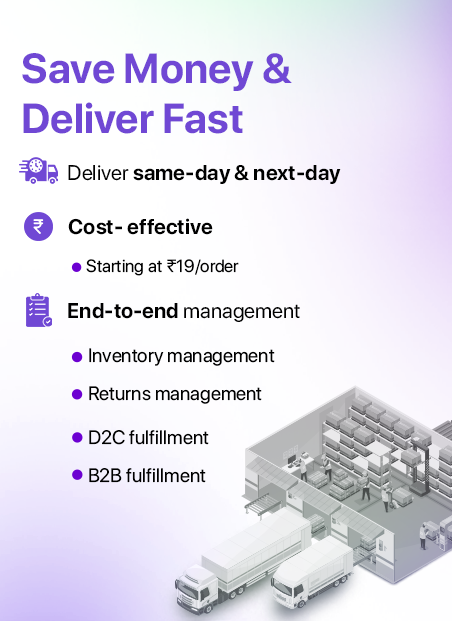
Managing inventory across multiple channels and locations can be complex and challenging, but Shiprocket Fulfillment can simplify the process. Some of the features that can help in smarter stock management and inventory optimisation are:
- We have warehouses across India to minimise delivery times and costs.
- You can monitor and track your inventory levels in real time with the help of a single dashboard.
- Orders are picked, packed, and shipped automatically with the help of automated order processing.
- We help in handling returns quickly while updating customers instantly.
- We help you gain insights into top-selling items and restock according to demand.
Conclusion
Inventory optimisation is a way to grow your business. When it is done right, it can save money, meet customers’ expectations, and grow faster without any chaos or issues. With the right strategy, metrics, tools, and services, such as Shiprocket fulfillment, you can manage your inventory efficiently.
So, get ready to take control of your stock and simplify your fulfillment. And power your business today!